Frequency inverters are particularly important components in livestock barn ventilation systems, fans, pumps, feeding systems and grain ventilation systems. They regulate the speed of motors and ensure that air flow, temperature, humidity and energy consumption remain in the correct balance. If an inverter fails in summer, it is not just a single machine that comes to a standstill, but often a critical operational process.
Why older inverters fail in hot weather
Many frequency inverters operate without any issues for many years. Inside, however, components such as fans, capacitors and electronic parts are subject to ageing. If a heatwave then occurs, the strain on the system increases significantly. Dust, moisture, stable air and high ambient temperatures further exacerbate the situation.
Typical signs include:
- Over-temperature warning on the frequency inverter
- Occasional shutdowns in hot weather
- Fan faults or loud fan noise
- The inverter no longer starts
- Ventilation in the barn is only partially operational
- The motor hums but does not rev up properly
Anyone searching for terms such as ‘faulty frequency inverter’, ‘broken inverter in agriculture’, ‘replacement frequency inverter for livestock housing ventilation’ or ‘frequency inverter overheating’ in this situation usually does not need theoretical troubleshooting, but rather a practical replacement solution.
A 1:1 replacement is not always the best solution
When an old inverter fails, the first thought that springs to mind is: find the same model, remove it and replace it. In many cases, this is possible. Technically, however, it is not always the most sensible solution.
Older frequency inverters were often installed in control cabinets that are only of limited suitability for agricultural environments. Dust, moisture, cleaning operations, temperature spikes and corrosion all take their toll on the entire system. If an old unit is simply replaced with an equivalent model, the original weak point often remains.
That is why, in the event of a drive failure, it is worth taking a look at the system’s design: Is a dedicated control cabinet required? Is the cooling adequate? Is the drive easily accessible? Can the new drive be fitted directly next to the fan or the machine? Is the parameterisation easy to understand, even during servicing?
IP66 frequency inverters as a robust replacement solution
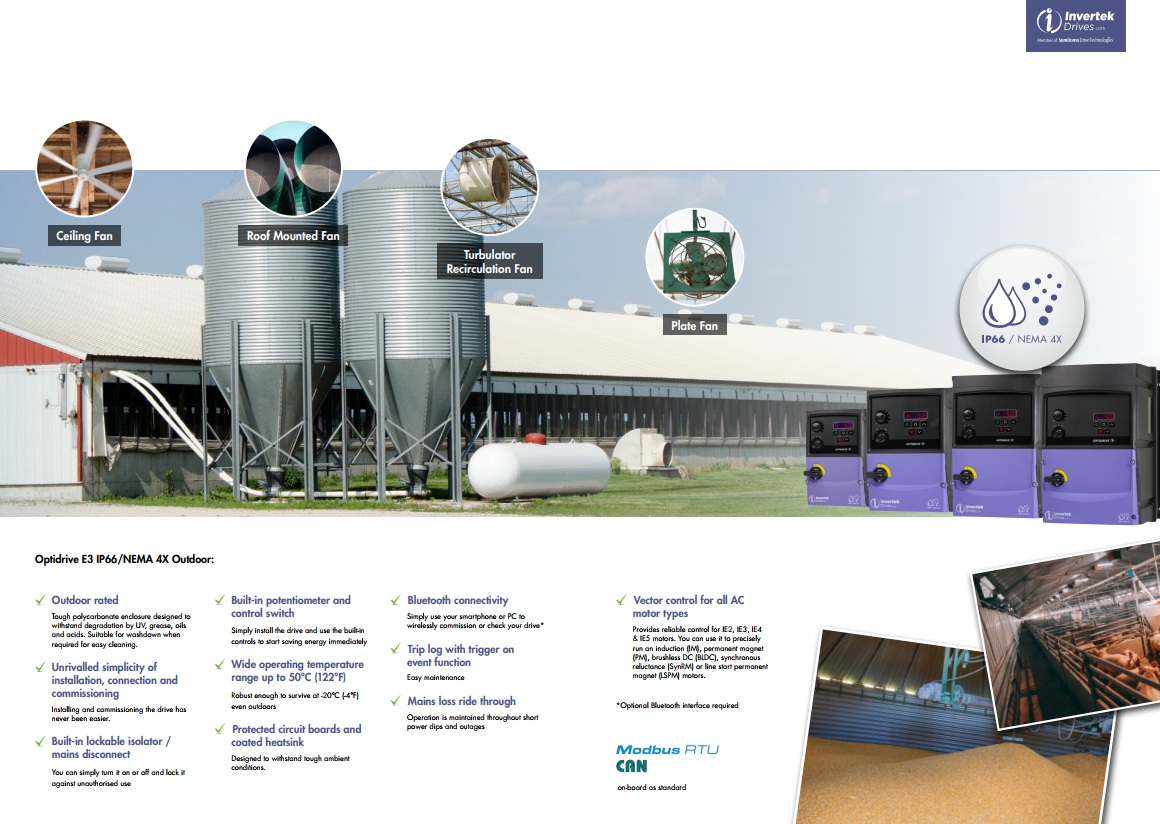
For many agricultural applications, a stand-alone IP66 frequency inverter is a practical alternative to a conventional control cabinet unit. IP66-rated units are designed for more demanding environments and can be installed in the immediate vicinity of the application.
This is particularly relevant for:
- Stable ventilation systems
- Wall-mounted fans
- Ceiling fans
- Exhaust ventilation systems
- Pumps
- Grain and silo ventilation systems
- Agricultural ancillary facilities with dust and moisture
An IP66 inverter reduces the need for additional enclosures and makes the system more straightforward. In many cases, the inverter can be mounted directly on the wall or close to the motor. This makes servicing, operation and subsequent troubleshooting easier.
INVERTEK as the preferred IP66 solution
MOLL-MOTOR can supply products from leading manufacturers. When it comes to IP66, we have had the best experience with the British manufacturer INVERTEK. Their E3 product range is available with IP66 protection in a power range from 0.37 kW to 22 kW. Other series are also available with higher protection ratings, up to power ratings of 250 kW. At our site in Stockerau, Lower Austria, we hold over 1,000 frequency inverters in stock, ensuring rapid response and delivery times.
Easy to configure, back up and running in no time
In the event of a breakdown during a heatwave, every minute counts. A replacement frequency inverter must be suitable for the motor power, the mains voltage, the application and the required operating mode. At the same time, commissioning should remain straightforward.
Modern IP66 frequency inverters are designed for quick parameterisation. For typical fan and pump applications, the key settings can be clearly defined: motor data, ramp times, minimum and maximum frequencies, direction of rotation, start/stop command and setpoint.
This often makes switching from the old inverter to a modern solution easier than expected. It is not just the power output in kW that is crucial, but the application as a whole: the motor, the environment, the operation, the installation location and the required control system must all be compatible.
Replacement for frequency inverters in agriculture
MOLL-MOTOR provides support in selecting suitable frequency inverters for agricultural applications. We do not consider the inverter in isolation, but rather in conjunction with the motor, the application and the installation conditions.
If a frequency inverter has failed in an agricultural setting, the following are particularly helpful for a rapid assessment:
- Photograph of the nameplate on the old frequency inverter
- Photograph of the motor nameplate
- Details of the application, for example, barn ventilation or a pump
- Mains voltage and motor power
- Information on whether the inverter was installed in the control cabinet or directly on the machine
- Brief description of the fault message, for example, overtemperature or fan fault
On this basis, it is possible to determine whether a 1:1 replacement is appropriate or whether a robust IP66 frequency inverter would be the better solution.
Check now, before the next outage
The current heatwave highlights just how important robust drive technology is on farms. Anyone already using older inverters in ventilation, pumping or silo systems should not wait until the next breakdown to take action.
A modern, stand-alone IP66 frequency inverter may be the better replacement solution: robustly built, easy to configure, easily accessible and suitable for demanding environments.
MOLL-MOTOR provides advice on the selection, specification and supply of suitable frequency inverters for agriculture, livestock housing ventilation, pumping applications and general drive technology.